Accelerating a decade of impact from the USC Alzheimer’s
Even after 35 years in Alzheimer’s disease research, Paul Aisen has never seen a moment quite like this. “Just in the last two years, we have reached the goal that we have been pursuing from the beginning,” he says. “We now have meaningful progress. Because of the Epstein family’s generosity, we’re moving the entire field forward for every researcher working on this disease.”
Dr. Aisen, a professor of neurology at the Keck School of Medicine of USC, founded its Alzheimer’s Therapy Research Institute in 2015 with a mission to rigorously test methods for early detection and treatment of dementia.
The goal that ATRI reached? Full approval from the Food and Drug Administration for lecanemab, an antibody medication co-developed by USC researchers — and the first approved treatment to slow down progression of Alzheimer’s disease by 30%, reduce cognitive decline, and improve daily functioning in adults with the disease.
Lecanemab, which is sold under the brand name Leqembi, is the first successful drug of a completely new category of medications that target the disease biology of Alzheimer’s.
A primary driver behind the acceleration is the power of philanthropy. A transformative 2022 gift from the Epstein Family Foundation is helping to speed us toward a day when Alzheimer’s disease will not just be treatable, but preventable.
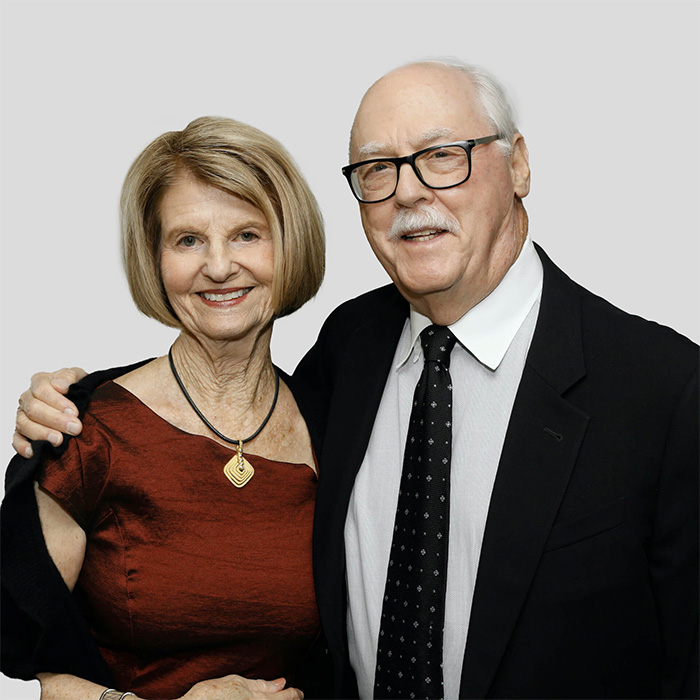
The $25 million investment from USC Trustee Daniel J. Epstein ’62 and his wife Phyllis “has had a major impact on our program,” Aisen says. Given as half of a $50 million joint gift to the University of California San Diego, the Epsteins’ contribution established a formal research collaboration between the two universities and supercharged their work in next-generation clinical trials, data sharing, and research into blood biomarkers as molecular signposts that can pick up on abnormalities in the brain — even before a positron emission tomography, or PET, brain scan.
Dan invests in USC because he expects us to bring effective solutions to the world, and Paul’s Alzheimer’s breakthroughs are making that a reality — thanks to Dan and his family, we are launching the era of prevention.”
Investigations into prevention are so new that it was impossible for ATRI researchers to get funding for their early work from the National Institutes of Health. “We needed another funding mechanism,” Aisen says. “That’s how the Epstein award has taken us in a new direction.”
“The next big step is primary prevention,” he adds. That means monitoring aging adults and fixing abnormalities before they can even lead to Alzheimer’s — something nearly unimaginable a decade ago.
“We have a clear path and have begun our work,” Aisen says. “Because of Dan’s remarkable generosity.”
